For a comfortable cycling practice, it is important to adjust your bike properly. When you start the bike it is important to have a good setting, so that you do not have pain and get disgusted with cycling. But also for the most diligent ones who already practice cycling and chain the long hours of saddle.
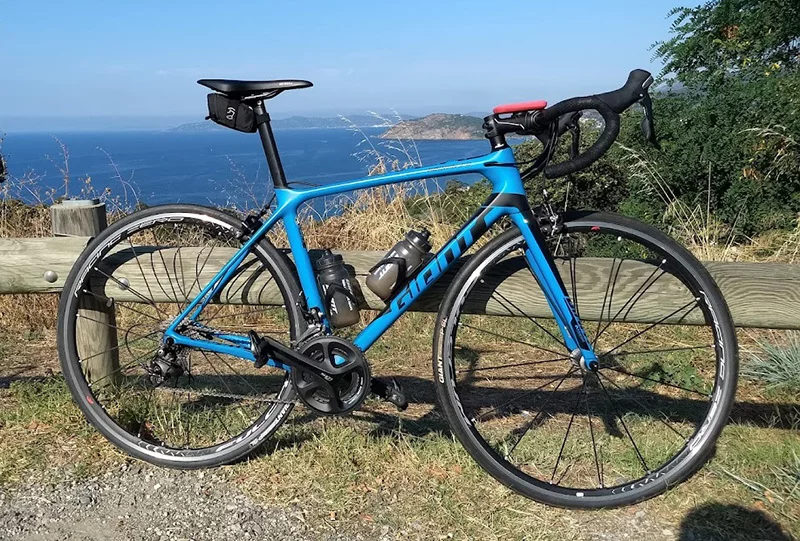
The purpose of this article is to give you basic advice on how to adjust a bike and what elements can be modified without charge. We give you the basics, in case you have chronic pain do not hesitate to go to a professional. Sports osteopaths or sports doctors can help you find the cause and optimize the position on the bike.
In this article, we will focus on road bikes but in a second article we will come back to the specificities of mountain bikes.
Basic settings of the bike
There are some adjustment elements on your bike which does not require any fees, only a little time. To make an adjustment without too much problem put your bike on an indoor bike trainer or a solid foot on the ground so that you are stable once you climb on it.
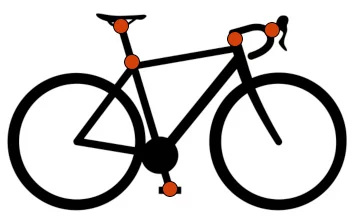
Equipment you need:
- Tape meter
- Hexagonal Allen keys or star keys
- Pencil
The position of the foot on the pedal
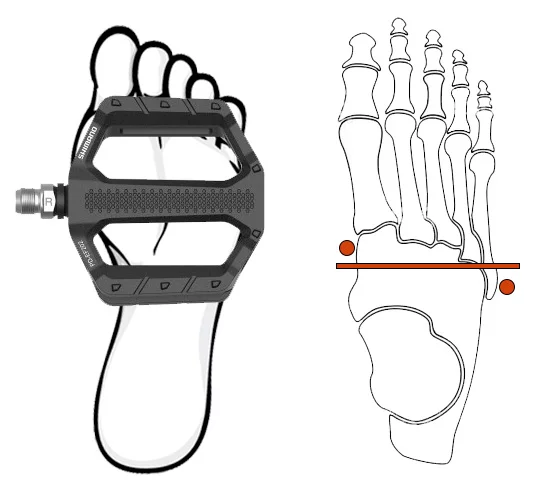
First of all, you need to know something essential about the foot positioning at the pedal level. Whether with flat or automatic pedals, the rule is the same. It is necessary to press with the part of the foot where the Cuneiform bone is located to have a good point of support, otherwise you will have pain and cramps if you pedal with the top of the foot or the middle of it.
The saddle height
For a "loosing" use of the bike, once on the saddle, right or left leg strained. Position your heel on the pedal now your leg must be stretched, if this is not the case change the saddle height. Once the position is correct, it is the right height knowing that you pedal with the front of the foot and not the rear.
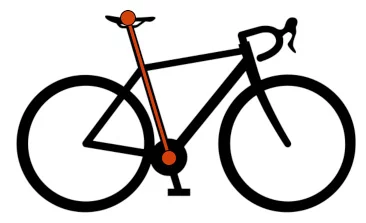
For the most sporty, we will use a small calculation for the base position of the saddle. You need to measure your "between legs", simply back to the wall place the pencil between your legs and climb as high as possible. Finally measure between the pencil and the floor, you will get your "in-legs". Multiply this number in cm by 0.885, you have just obtained the distance between the center of your pedal boat and the center of the saddle. You can position this one, it's a theoretical height. It will then have to be refined according to the sensations during your trips but it is suitable for most cyclists.
The advancement of the saddle
The theoretical method of lead wire:
- Riding on the bike
- Set the right or left pedal 90 degrees
- Sit comfortably on the saddle
- Put a lead wire along your knee
- The wire must dive at the pedal axis
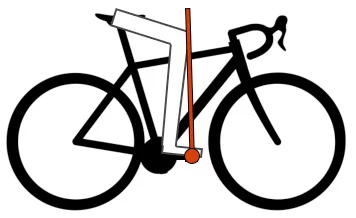
Again, you should not hesitate to test the different settings on an output of 1h for example. If you are more comfortable being placed on the front of the bike, you need to lift the saddle slightly and move it forward. Above all, change your configuration by half a centimeter.
Stool tilting
There are many types of saddle, but what is important is to tilt it slightly so as not to compress the perineum. I recommend between -2% and -4%, it's a matter of sensation but you don't have to slip the saddle and find yourself stretched on your arms. If you do not have an electronic level, you can use one of the available mobile applications.
Position of coconuts
It is also possible to play with the position of the casseroles, above all it is necessary to stay flexible on the shoulders. Do not be too stiff on the hanger at the risk of getting pain at the bottom of the back or at the neck. Do not hesitate to climb or descend these, you can also tilt them in to have a more natural position of the hands.
Go further in the settings of the bike
Postural studies
Be careful not to confuse the "positions" often "offered" when buying a new bike by your bike shop and the "postural study" carried out by medical and sports professionals. This makes it possible to improve the pedal stroke and to be much more efficient on the bike but also to get the best position.
Being based in the North of France, I can advise you Edward Hervé who is an osteopath and specialist in cycling. Not far from Lille, it will welcome you for a complete study and a follow-up post study.