Saturday 1st April 2023, I left the Tour of Flanders Challenge in the city of Oudenaarde (Audenarde in French). We are therefore in Belgium, specifically in the province of Flanders. Oudenaarde is the arrival city of the Tour of Flanders since 2012.
The Tour of Flanders is better known as De Ronde Van Vlaanderen (name in Flemish). This race is part of one of the 5 monuments of the professional cycling season, with Paris-Roubaix, Liège-Bastogne-Liège, Milan San Remo and the Tour of Lombardy.
Tour of Flanders Challenge routes
There are 4 distances on this challenge, which bring together the main difficulties of the Tour of Flanders. It is possible to align on the almost integral route of 242 km (2536 m D+), 177 km (2338 m D+), 144 km (1929 m D+) or 75 km (973 m D+).
- Molenberg
- Marlboroughstraat
- Valkenberg
- Eikenberg
- Koppenberg
- Mariaborrestraat
- Taaienberg
- Berg Ten Houte
- Kanarieberg
- Oude Kwaremont
- Paterberg
Conditions on this Tour of Flanders Challenge
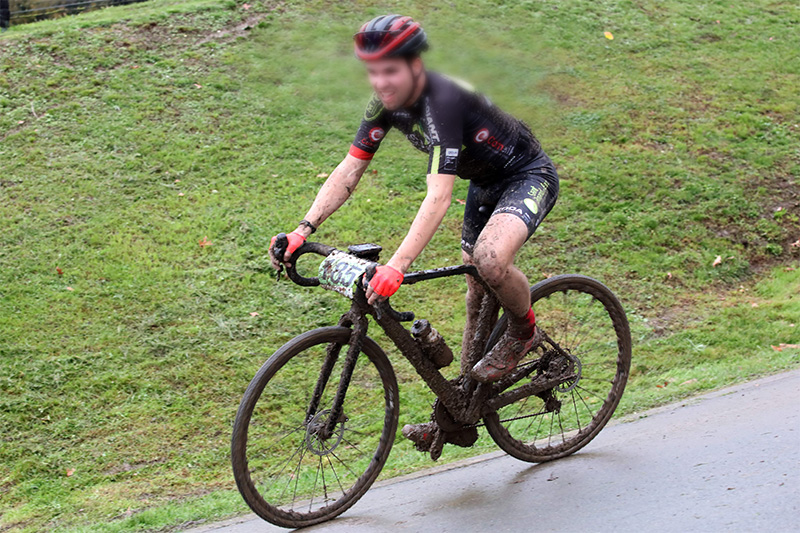
On D-Day, the weather wasn't really with us. Grey and rain will accompany us during the 6h of rides for our 144 km. From the start, it is quite simple to find small groups of cyclists to ride. But the bumps arrive quickly and the groups do not last long depending on the rhythm of the participants.
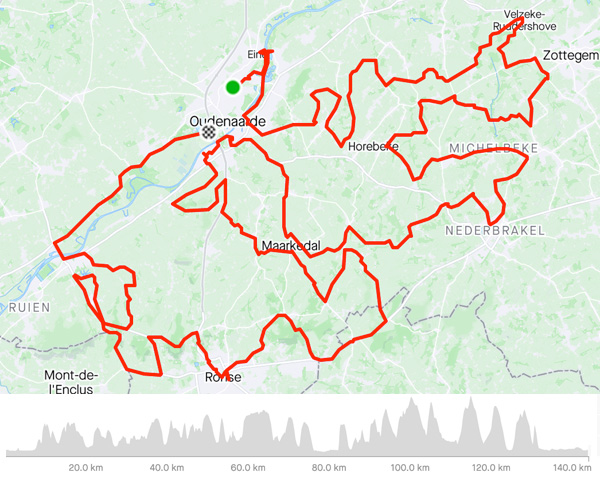
The first 60 kilometers are done fairly quickly in the good mood, under a slight spit. We pass the main difficulty, the Molenberg. But once you have reached the level of Nederbrakel, heading west and then north west to go back to Oudenaarde. It is with a wind of face that we approach these 20 long kilometers with little interest. We arrive at the refuelling, which allows to restock energy for the last part of the journey. Who has all the mythical difficulties of this Tour of Flanders.
Here we go for a chain of climbs-descents of banks with or without pavements, the Berg Ten Houte, Kaperij, Kanarieberg, Kruisberg, Oude Kwaremont and Paterberg. The different participants are more or less in pain but all the world is tightening their teeth. But once the Paterberg climbing down and down, there is only "12" km left to reach the finish line. I found myself in a group of Italians who were driving quite hard, 30km/h average after 6 hours of effort.
My bike for the Tour of Flanders Challenge
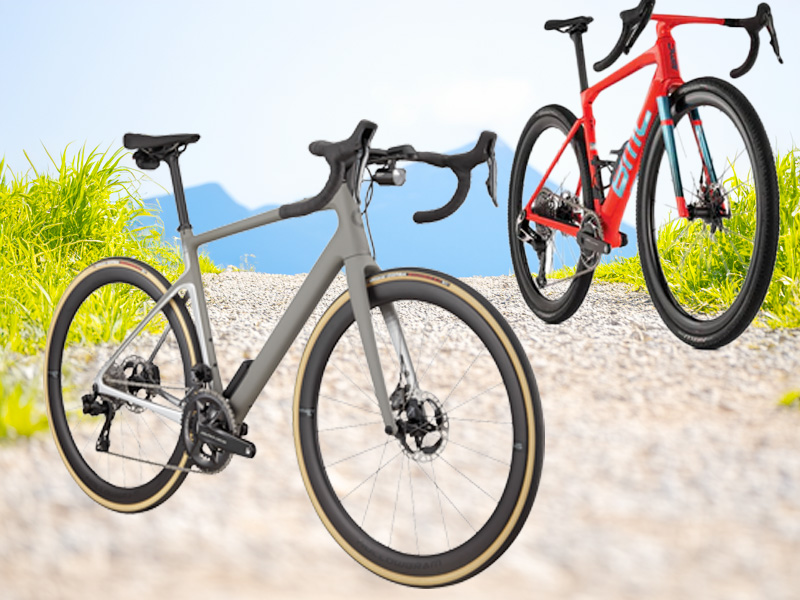
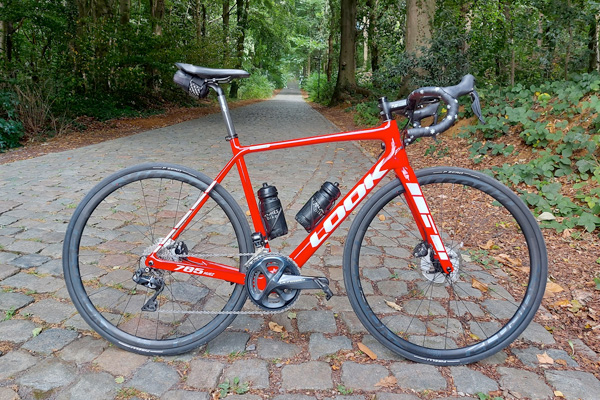
In contrast to the Paris-Roubaix Challenge, where the use of a bike Gravel it is not to be excluded. Here on the Tour of Flanders, I used my road bike mounted with 28 mm tyres. The pavements are not as aggressive as on Paris-Roubaix and they have often gone uphill, so with a reduced speed. I used inner tube with a pressure of 5.5 bar in each wheel, for a weight of 69 kg.
It is best to leave with 2 spare tube inner to avoid any problems.
Assessment and specificities
The Tour of Flanders Challenge takes place in Belgium, the country of cycling, where the Flemish are known for their exemplary organization of cycling events. The removal of the bib before the start of the race is done quickly and efficiently, thanks to the use of free bike parking.
Among the highlights of this event are the extensive supplies available to participants.
However, a major weakness concerns the price of the event, which amounts to 70€ for the 144 km course. In addition, the organization requires a deposit of €10 for the frame plate, refundable on arrival in exchange for a bag of goodies or a t-shirt. Unfortunately, unlike other events such as the Paris-Roubaix Challenge or the GF Mont Ventoux, no medals are expected at the finish. If you want to get this beautiful reward and add it to your personal collection, you will have to pay a small sum of €10, which can be seen as a questionable business practice.
Another disappointment concerns the route itself, which obliges participants to take bicycle paths. This becomes extremely dangerous when you are surrounded by a pack of 30 cyclists. Furthermore, if you want to enjoy the different climbs (bergs) at your own pace, it is better to leave early, otherwise you may have to walk in the coasts. The shorter course of 70 km starts later and also has a level difference. Unfortunately, many cyclists eventually climb the climbs on foot, which blocks the other participants who can cross them in the saddle.
Nevertheless, what remains in memory during this cycling event is the friendly atmosphere where all participants share the same passion for cycling and the pleasure of participating in the event. There is a great variety of nationalities, like the Paris-Roubaix Challenge.
It is important to note one particular feature: the arrival area of the cyclosportive is 3 km from the official finish line of the Tour des Flandres.