Every last Sunday in April, Walloon roads become an arena for one of the most mythical cycling races in the world. Liège-Bastogne-Liège, the Dean of Classics, is not just a one-day race. It is a living monument, a trial that devours champions as much as it reveals them.
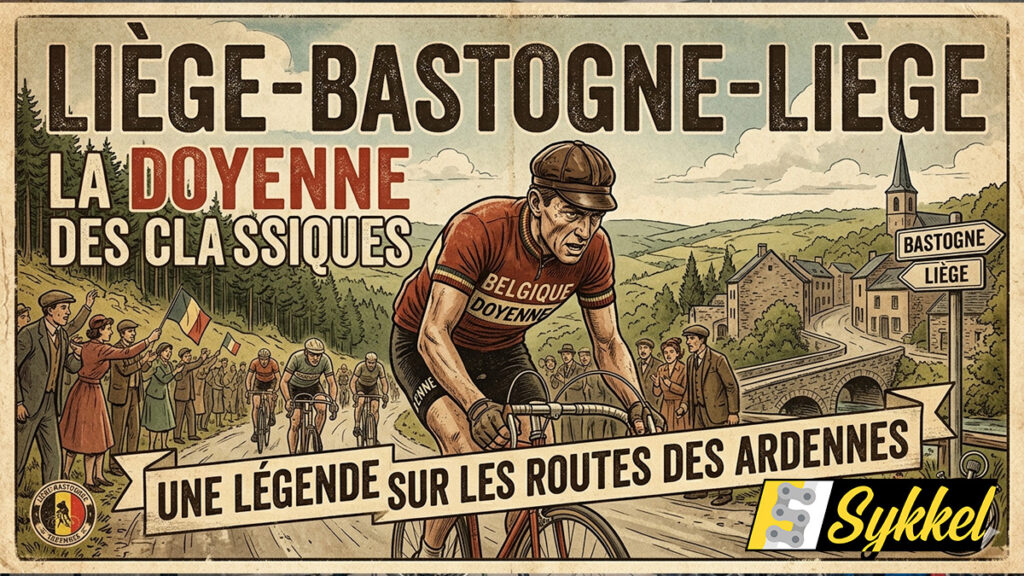
A story of more than a century old
Liège-Bastogne-Liège was born in 1892, organized by the Liège Vélo Club. At that time, professional cycling did not even exist. The very first edition was won by a Léon Houa, from Liège, after more than ten hours spent on his bike. The second runner crossed the finish line twenty-two minutes late. The third, forty-four minutes. And runners will continue to arrive for another five hours.
This detail says everything about Liège-Bastogne-Liège: a race that saves no one.
Houa won again in 1893 and 1894, laying the first stones of a legend. The race then goes through wars, interruptions, scandals — like this 1957 edition where two riders are declared ex æquo after a favourite crossed a closed level crossing — and grows up with the century. In 1959, the Doyenne joined the Superprestige, the ancestor of the UCI World Tour, confirming its status as one of the world's greatest cycling events.
The journey: the Ardennes as a justice of the peace
About 260 kilometers. Some 4,700 meters of positive elevation. Eleven ribs classified, some of which have become names engraved in the collective unconscious of cycling: the coast of Stockeu (1.1 km to 12.2% of the average slope, with passages at 21%), the Haute-Levée, the Redout — the moment of truth of the race — and the Roche-aux-Faucons, the ultimate judge at only 13 km from the finish.
The route descends south from Liège towards Bastogne, at the gates of Luxembourg, before going up to the ardent city by a tortuous route through the valleys dug by the Ourthe and its tributaries. It is this moving back and forth, this accumulation of repeated difficulties, which distinguishes Liège-Bastogne-Liège from all the other classics. Here, there are no cobblestones or sea wind: just the mountain, again and again, until the legs return the weapons.
Unforeseeable weather: when the Dean becomes ruthless
To fight at the end of April in the Belgian Ardennes is to agree to play the weather roulette. The race was hit several times by extreme conditions, notably in the 1919, 1957 and 1980 editions.
The 1980 edition remains the most famous in this respect. Named Snow-Bastogne-Snow by the commentators of the time, she fights under a snowstorm from the beginning, in temperatures close to zero. In one hour of racing, more than half of 174 leave. At the finish, only 21 riders are ranked. The winner? Bernard Hinault, who won solo with more than nine minutes ahead of his dolphin. A warrior's victory, which has become eternal.
This permanent weather risk is part of the race's identity. Cold rain, Ardennes fog, late frost: each edition can tip into the epic or nightmare according to the whims of a spring sky that has not yet decided whether it belongs to winter.
The great winners: a gallery of legends
Liège-Bastogne-Liège has crowned the greatest champions of each generation.
Eddy Merckx dominates the race as he dominated his time. Five victories — 1969, 1971, 1972, 1973 and 1975 — including three consecutive ones. Its 1971 edition is particularly astounding: a 92-kilometre solo escape under snow and cold conditions. The Cannibal in its pure state.
Moreno Argentina four times in the 1980s (1985, 1986, 1987, 1991), with the unofficial title "King of the Ardennes". Alejandro Valverde equals this record with four successes also (2006, 2008, 2015, 2017), adding to its collection an impressive regularity over more than a decade.
Bernard Hinault twice won, always under difficult conditions — including this 1980 edition, which became mythical. Philippe Gilbert, the child of the country of Liège, offers in 2011 a victory in its region to a people of fans in delirium.
And then there is Tadej Pogačar. The Slovenian is writing his own chapter in the history of the Dean. In 2021, 2024 and 2025, he won each time with a disconcerting ease. During the 111th edition, held on 27 April 2025, he attacked alone on the Redoute coast 35 km from the finish — sitting on his saddle without even getting into a dancer — and crossed the line more than a minute ahead of his pursuers. His ninth career monument.
The five Monuments: Liège in its pantheon
Liège-Bastogne-Liège is one of the five Monuments of cycling, these one-day races which constitute the top of the classic calendar. To understand the place of the Dean, here is a quick overview of this elite family.
Milan-San Remo (mid-March, ~295 km) is the longest and often the most unpredictable of classics. Nicknamed "the Primavera", it runs from Lombardy to the Ligurian Riviera and usually ends with a sprint or attack in the Cipressa and Poggio.
The Tour of Flanders (early April, ~272 km) is the great Flemish festival, with its paved walls — the Old Quaremont, the Paterberg — and its hundreds of thousands of supporters by the road. An institution in Belgium, especially north of the country.
Paris-Roubaix (mid-April, ~260 km) is the mud and pavement race, the "North Hell". It does not need climbs: it is the brutality of paved areas that selects men.
Liège-Bastogne-Liège (end of April, ~260 km) — the Dean, the oldest of all, that of the climbers-punchers, the Ardennes and the spring cold.
The Tour of Lombardy (October, ~250 km) closes the classic season in autumn, in the flamboyant setting of Italian lakes. Nicknamed "the classic of dead leaves", it rewards the runners at the end of the season.
Five races, five characters, five stories. Liège-Bastogne-Liège is the oldest member of this group. And she wears this title with absolute dignity.
A race of one day, an emotion of a lifetime
What makes Liège-Bastogne-Liège unique, at the bottom, is this tension peculiar to one day races: everything is played in a few hours, often in a few seconds on a coast. No tomorrow to make up for, no bonus to recover. An attack, a hesitation, and everything is done.
Since 1892, the Dean has seen more than a century of champions, impossible weather and reversed tactics. She saw Merckx rule, Hinault resist the storm, Valverde win as king of the Ardenne, and today Pogačar fly on roads that others struggle to climb.
Liège-Bastogne-Liège, the Dean of Classics, has not aged. It has grown, like the great wines of the region. And every last Sunday in April, it reminds us why cycling is much more than a sport.
See you next year, quay of the Ardennes.