Critical Power (CP): A key concept for cycling training
Critical Power (CP) is a fundamental concept of exercise physiology that has gained popularity in the cycling world with the democratization of power meters. Beyond a simple figure, it is a true keystone to understand your cycling profile and plan your training with surgical precision.
Critical Power vs. FTP: A crucial distinction
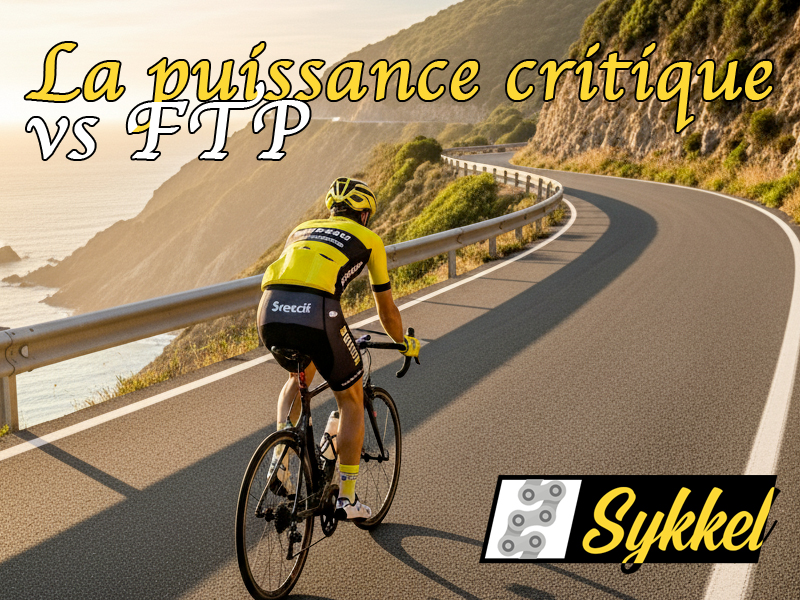
Debate between Critical Power (CP) and FTP (Functional Threshold Power) is common. If the two concepts are aimed at determining a power threshold, their approach is different, and that is what makes their respective strength.
- FTP (Functional Threshold Power): This is the maximum average power that a cyclist can maintain over a 60 minute period. In practice, it is often estimated from a 20-minute test (95% of the average power on this test). FTP is an excellent indicator of aerobic endurance, but it does not take into account your ability to produce intense and short efforts.
- Critical Power (CP): It is a mathematical model that describes the hyperbolic relationship between power and duration. Theoretically, this is the power you can maintain for an "infinite" duration. In reality, it corresponds to the intensity above which your metabolic state can no longer stabilize. The Critical Power model introduces a second variable: the W' (pronounce "W premium"). The W' is the anaerobic energy reserve, a work "reservoir" that you can use for effort above your CP.
The major difference: The FTP is a unique and punctual point, while CP and W' form a model that offers a more dynamic view of your profile. If your FTP and CP are close, this means that your anaerobic capacity (your W') is low. If your CP is significantly lower than your FTP, this may indicate a strong ability to tolerate intense efforts, but a substantial endurance to improve.
Why use Critical Power?
The use of Critical Power has many advantages for training and competition:
- Better accuracy: Unlike the 20-minute FTP test, which may overestimate your threshold, the CP-W' model is based on several efforts (usually 2 or 3 tests of different durations, e.g. 3 and 12 minutes). This offers a more robust modeling of your physiological abilities.
- A complete view of your profile: CP gives you your aerobic endurance, while W' quantifyes your ability to tolerate intense efforts. This gives you a more complete view of your strengths and weaknesses, whether you are a pure climber, a sprinter or a rider.
- Running effort management: Critical Power, associated with W', predicts how long you can maintain a given power above your CP. It is a valuable tool to plan a time trial or manage a escape, avoiding "emptying" your W' tank too quickly.
- Smarter training planning: The CP-W' model allows precise physiological adaptations to be targeted. You can focus your efforts on increasing your CP (long and sustained aerobic work) or developing your W' (short and intense intervals), depending on your goals.
A tool for all levels?
Yes, Critical Power is a concept that applies to all levels of practice, from leisure cyclists to seasoned competitors.
- For the beginner: This may seem complex at first glance, but the basic principle is simple: it is to train at different intensities to progress. CP provides a clear framework for structuring these efforts.
- For the confirmed cyclist: It is a precision tool to refine its preparation. Knowing your CP and W', you can adjust your training in millimetres, for example by targeting efforts to fill an identified weakness.
How to work his Critical Power?
Critical Power training must stimulate both aspects of the model: CP and W'.
- Increase CP (aerobic threshold):
- Threshold sessions: Prolonged efforts close to your CP (90-100%). For example, 2 x 15 minutes to 95% of CP. These sessions improve your ability to sustain an intense effort over time.
- Endurance exits: The long, moderate-intensity outputs (Zone 2/3) are the basis. They develop your aerobic system and "stitch" your CP upwards.
- Develop the W' (anaerobic reservoir):
- Overcritical Intervals: Short and intense efforts, well above your CP. For example, 2- to 5-minute intervals at 105-120% CP, with recovery phases to allow W' to partially recharge.
- "Active recovery" intervals: Alternate very intense (15-30 sec) efforts with easy recovery phases (2-3 min) to stimulate the body's ability to re-synthesize anaerobic energy.
- Muscle strengthening: Gross force is an essential performance factor. A good weight program (squats, slots, etc.) or strength program on the bike (high brace, low pace) can increase your ability to produce power, and therefore, your Critical Power.
For what purpose?
Critical Power training is relevant for many purposes:
- The time trial and the long climbs: The objective is to increase CP to maintain high power over time.
- Stage races or cyclosports: A high W' is crucial to respond to attacks, restart after a turn or make the final sprint.
- Effort management: Understanding your CP and W' allows you to avoid "lead pads" while running, managing your efforts and knowing when you can or can't attack.
In conclusion, the Critical Power is a complete training model that goes beyond the simple FTP. By calculating and using it, you transform your training into a more scientific, accurate and personalized approach to achieving your performance goals, regardless of your level.