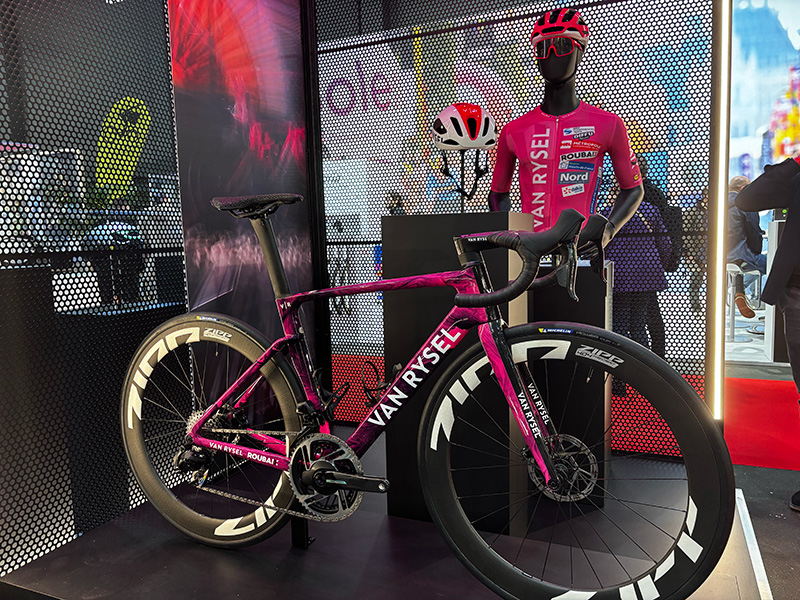
The most aerodynamic bike of the peloton accessory to the general public — finally.
The World Tour bike... at Decathlon
There is something a little dizzying to see a bike co-developed with the Decathlon AG2R La Mondiale team — and used on the biggest races of the UCI circuit — available on the website of the great sports brand at €4,500. However, this is the promise of the RCR-F Pro: pure competition, without prohibitive price filters.
The RCR-F (the "F" for Fast) is Van Rysel's aero response to the classical RCR. Where the RCR-F is looking for a versatile balance, the RCR-F fully assumes the DNA of a plains courier — a bike designed to go fast on rolling runs at speeds between 35 and 50 km/h.
A framework born in wind tunnel
The development of the RCR-F took place hand in hand with Swiss Side, a recognized specialist in aerodynamic optimization. CFD simulations, wind tunnel tests, field validation by pro riders: nothing was left to chance. The result is uplifting: the RCR-F gains 13 watts on the classic RCR at 45 km/h. At this rate, it's several minutes recovered on a 200 km stage.
"13 watts less than 45 km/h. Aero is no longer an option for serious cyclists."
The rigidity was not sacrificed on the altar of the Aero Profile. The Super High Module carbon "Pro" layout, consisting of 517 hand dredging pieces, makes the frame 7% more rigid than the RCR Pro on the head tube. This increased rigidity is directly reflected in the explosive phases: attacks, sprints, coastal recovery — energy is not leaking anywhere. The frame weighs 1 010 g in size M for 420 g on the fork.
| Ideal terrain: less than 1,500 m D+ per 100 km, average speeds of 35 to 50 km/h. The traditional RCR Pro remains the choice for the mountain. |
SRAM Rival AXS E1: electronics without compromise
This RCR-F Pro is equipped with SRAM Rival ETAP AXS E1 in 2x12 speed version. The word "Rival" might be misleading: in the SRAM hierarchy, this group is not content to have entered the electronic range. It is accurate, reliable, and shares the wireless and cable-free philosophy that has made AXS's reputation.
Two independent batteries — one per derailleur — guarantee reassuring redundancy during the race. The SRAM Connect application allows you to customize the passing sequences and access the output data. The 10-36 tooth cassette offers a wide development tray, compatible with unexpected reliefs.
The power meter Quarq: training otherwise
One of the strongest arguments of this configuration is the native integration of a Quarq power meter directly into the SRAM Rival E1 DUB (48/35T). No more need to invest 300 to 600 € extra after the purchase: the wattmeter is there, from the first exit.
For those who really want to progress — thresholds, training areas, race preparation — it is an indispensable tool. Its presence in a configuration at €4,500 radically changes the budgetary equation in the face of competition.
Cockpit, wheels and finishes: everything is thought out
The cockpit is provided by an exclusive DEDA × Van Rysel RCR-F combo, with Ergo Drops inserts to improve grip in the hanger hollow – a detail that makes all the difference in the extended aero position. The GPS support is included of origin, compatible Garmin, Wahoo and Bryton.
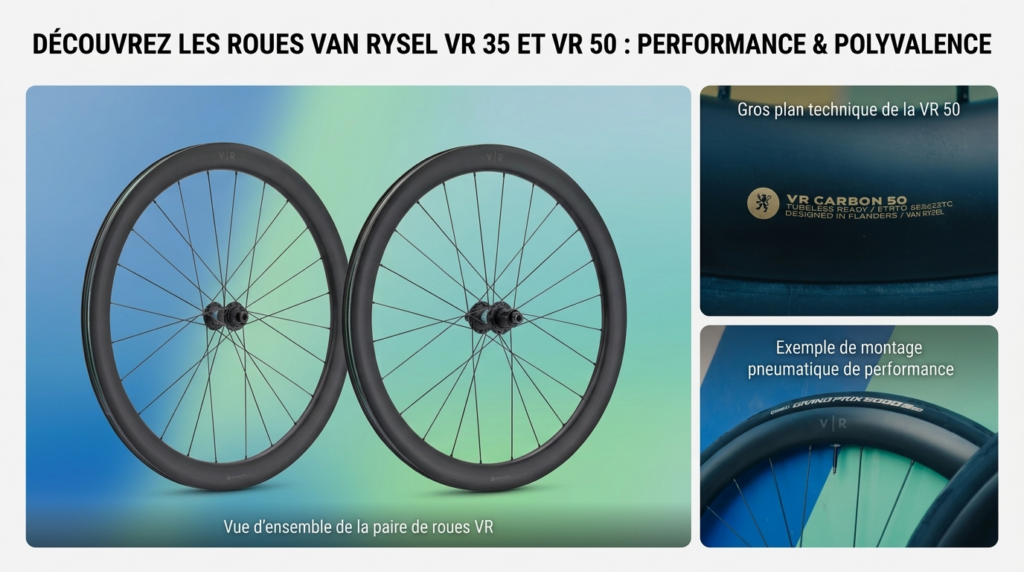
The VR 50 Carbon wheels (50 mm rim, 1550 g the pair) are mounted on DT Swiss DT370 hubs, with Continental GP 5000S TR tyres in 28 mm tubeless-ready. The tubeless system comes complete: valve and preventive fluid included. A detail that counts on a race car.
Data sheet of the Van Rysel RCR-F Pro
| Framework Carbon Super High Module, 1 010 g (M) | Fork Carbon, 420 g |
| Group SRAM Rival ETAP AXS E1, 2×12v | power meter Quarq (integrated into the pedal) |
| Development 48/35 · cassette 10-36 | Brakes Hydraulic disc, 160/140 mm |
| Wheels VR 50 Carbon, 1,550 g (pair) | Tyres Continental GP 5000S TR 28 mm |
| Cockpit DEDA × Van Rysel RCR-F integrated | Sizes XXS · XS · S · M · L · XL |
Our verdict
The Van Rysel RCR-F Pro with SRAM Rival AXS E1 is a difficult proposal to ignore for the competitive cyclist with a reasoned budget. World Tour frame, reliable wireless transmission, integrated power meter, 50 mm carbon wheels: the list is impressive. The limit is clear — it excels on the flat and the hilly, less in pure mountain. For collar lovers, the RCR Pro remains the right choice. But for the majority of athletes looking for speed on classic routes, it is a dreadfully complete bike.
- Aerodynamics: 9.6
- Rigidity: 9.2
- Transmission: 8.8
- Value for money: 9.4