For winter and rain, choose a road tyre whose rubber is intended for use on cold and wet pavement, with puncture protection adapted to your roads. A section of 28 to 32 mm can be a track on a compatible bike, but the correct width depends first on the frame and the wheels. The best compromise is not necessarily the heaviest, most carved or widest tyre.
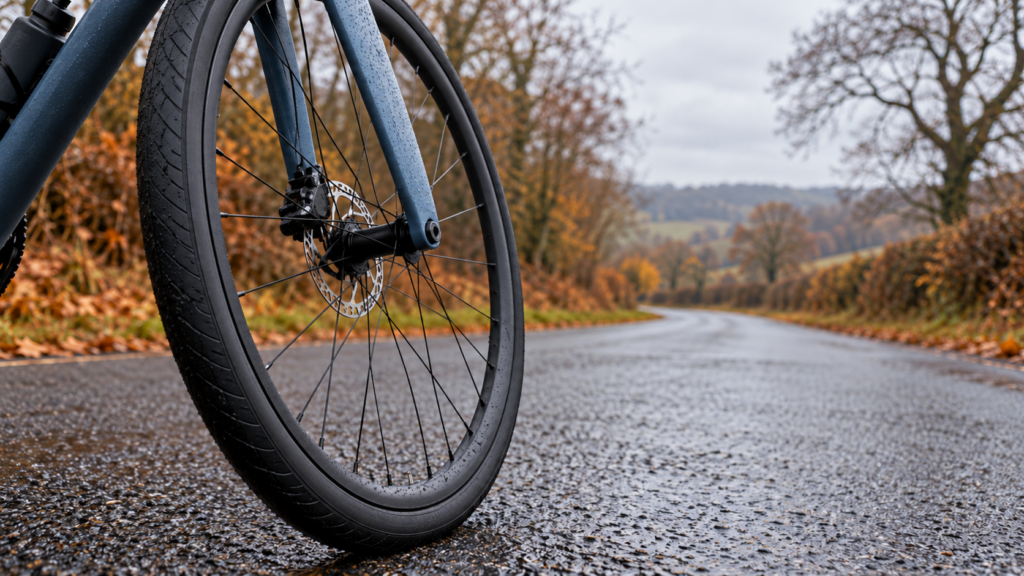
Three families deserve your attention: an all-season sports tyre like the Continental Grand Prix 5000 AS TR, a versatile reinforced model like the Pirelli Cinturato EVO TLR, or a training tyre with an inner tube like the Schwalbe One 365. The following characteristics come from the manufacturers, consulted the 2 November 2026. This guide is not based on a Sykkel comparative test or on braking measurements performed for the occasion.
Adherence and anti-puncture: two different qualities
Puncture protection is intended to prevent debris from crossing the carcass. It does not guarantee bend grip. Conversely, a rubber presented as high performance in the rain does not make a tyre insensitive to flints and cuts. These two characteristics should be read separately.
For usually dirty roads, prefer a carcase protected under the tread and flanks adapted to the risk of cutting. For quick exits on a fairly clean bitumen, all-season sports construction can keep more interest. The compromise is between flexibility, protection, mass and behaviour of gum; a simple list of proprietary technologies does not provide an objective ranking.
Visible sculptures are also not enough to recognize a good rain tyre. On asphalt, a smooth tyre can offer good grip with a suitable rubber, as explained by Schwalbe in its Profile FAQ. Drawings become more useful when the surface contains soil or furniture. So do not choose a large gravel profile only because it rains on your road route.
Three current references for separate uses
| Reference | Construction and sections to be considered | Proposed use | Limit to keep in mind |
|---|---|---|---|
| Continental Grand Prix 5000 AS TR | Tubeless Ready; 25, 28, 32 and 35 mm in the 2025/26 catalogue. Black Chili gum, Vectran protection. | Sports outings looking for an all-season model. | You must check the authorized mounting for the section and rim; "AS" does not guarantee any puncture or adhesion on ice. |
| Pirelli Cinturato EVO TLR | Tubeless Ready; in particular 28, 30, 32 and 35 mm. SmartEVO AS and reinforced construction. | Endurance, imperfect roads and journeys combining sport and daily use. | Its versatile and reinforced positioning is not that of a pure competitive tyre; no quantified performance advantage is established here. |
| Schwalbe One 365, Tube version | Mounting with chamber; in particular 25, 28 and 32 mm. ADDIX 4-Season and RaceGuard protection. | Regular training with a classic mounting. | This version is not tubeless. The One 365 Tubeless version is a separate product to be explicitly selected. |
Continental Grand Prix 5000 AS TR: keeping a sporty approach
The GP 5000 AS TR is the AllSeason version of the GP 5000 family. It combines the BlackChile mixture with a Vectran protection. The official catalogue 2025/26 confirms the sections selected in the table. Do not confuse it with the classic GP 5000 room, S TR or TT TR.
It should be considered if you want to keep a sports road-oriented tyre during the bad season. This remains an editorial orientation taken from its positioning, not the conclusion of a comparative test. Continental also allows the use of its TR tyres with a chamber, subject to the compatibility and pressure of the set.
Pirelli Cinturato EVO TLR: an enhanced versatile option
The Cinturato EVO TLR succeeded the Cinturato Velo. Pirelli announces a SmartEVO AS gum designed especially for low temperatures and wet roads, and a construction designed for road, daily journeys and certain roads. The sections of 28, 30, 32 and 35 mm make it possible to study a road assembly according to the bike.
This model looks especially at whether your winter outings pass on a degraded bitumen and dirty portions, with more emphasis on robustness and comfort. The promises of grip and durability remain those of the manufacturer. They do not make it possible to say that it will brake better than the other two references on your road.
Schwalbe One 365: distinguishing the tubeless chamber tyre
The One 365 in a room aDDIX 4-Season and RaceGuard. Schwalbe positions it as a training tyre for all year round, with a gum adapted to the cold. It offers a simple track to keep an assembly with a chamber, especially on a bike whose wheels are not tubeless.
The One 365 Tubeless has its own sheet, carcase and dimensions and mass data. The close name does not make the two versions interchangeable. Check "Tube" or "TLR" for the reference ordered, and not just the short title of the store.
28, 30 or 32 mm: check the actual place
A larger tyre brings air volume and allows to explore other pressure settings with comparable load. It can improve comfort on rough roads. It can also be too large for your frame, brake calipers or mudguard: its interest depends on the complete mounting.
Start with the maximum width allowed by the bike manufacturer. Then check the place at the fork, at the bases, at the haubans and under the mudguards. Keep the required clearance, including when the wheel flexes slightly and debris accumulates. A tyre that just stops does not necessarily constitute an acceptable fitting.
The width shown on the sidewall is nominal. The measured width varies with the rim, pressure and construction of the tyre. Continental I explains in its guide to rim and tyre associations. A 28 mm can therefore take more space than expected on a larger rim. Measure after mounting and inflation before validating the release.
Wheel and rim compatibility: essential checks
Read the ETRTO marking, for example 32-622: 32 is the nominal width, 622 is the heel range diameter. The diameter must correspond to that of the rim. The internal width of the tyre must also be allowed with the selected tyre section.
Then check if the rim has hooks, if it is tubeless compatible and what tyres it accepts. A hookless rim imposes an explicitly compatible tyre and section, as well as pressure limits sometimes lower than those of the tyre on a hooked rim. The only mention "Tubeless Ready" never exempts from consulting the recommendations of the two manufacturers.
The continental compatibility documentation recalls that maximum pressure and permissible internal width depend on the application. Hold the most restrictive limit of the set. Adding a room does not make a rejected tyre compatible on a hookless rim.
Tubeless or inner tube for winter?
The tubeless can seal small perforations with its preventive liquid and allows to adjust the pressure-comfort compromise without risk of pinching an absent chamber. He remains exposed to cuts, air losses, heel displacement and rim shocks. Its interest requires correct mounting and regular maintenance.
Before winter, check the presence and condition of the preventive, the compatibility of its temperature range with your exits, valves and rim bottom. Follow the frequency indicated by the manufacturer of the liquid: it depends on the product and the conditions. Keep a troubleshooting solution suitable for assembly, including inflating.
The room remains relevant if you prefer a simple maintenance or if your wheels are not provided for the tubeless. Choose a room corresponding to the actual section of the tyre, with a fairly long valve. Butyl, latex and TPU have their mounting and maintenance constraints; check in particular the manufacturer's restrictions with your brakes and wheels.
In both cases, prepare your kit before leaving. Our guide repair and prevent a bike puncture details the gestures and equipment to take away.
Pressure adjusts for your mounting
There is no "rain" pressure for everyone. The total weight, distribution, measured section, rim, carcass, mounting and condition of the coating alter the adjustment. Copying the bars of another cyclist does not take these differences into account.
Use it sykkel pressure guide to understand the parameters, then the pressure calculator as a starting point. Always cross-check the result with the limits and recommendations of your manufacturers. Generic tables and adjustments cannot validate your editing alone.
Check the pressure gauge before rolling and adjust gradually within the permitted range. Do not systematically lower the pressure of a fixed value as soon as it rains: a tyre already close to its low limit could become unstable. Our article on the overinflating and underinflating explains the symptoms to be monitored.
The right tyre does not replace the right gestures
Regularly inspect cuts, debris and wear indicators. If the carcase appears or if a sidewall is damaged, the choice of a new tyre becomes a priority over any fine adjustment. In the rain, slow down before bends, gradually brake and beware of markings, metal plates, sheets and greased areas.
Finally, none of these road tyres guarantee sufficient grip on the ice. Choosing between these references is used to prepare cold and wet road exits; when the condition of the carriageway no longer allows for a reasonable ride, delaying the exit remains the useful decision.