For a long time, the cyclist flew at the sensation, pace, or at best at the heart rate. The power meter — or wattmeter — has changed the situation: it measures the force actually applied to each pedal tower and translates it into watts, an instant data that is insensitive to the variables that distort the cardio (fatigue, heat, morning coffee). The result is a reliable FTP, sessions calibrated to the nearest watt, and a measurable increase in season after season.
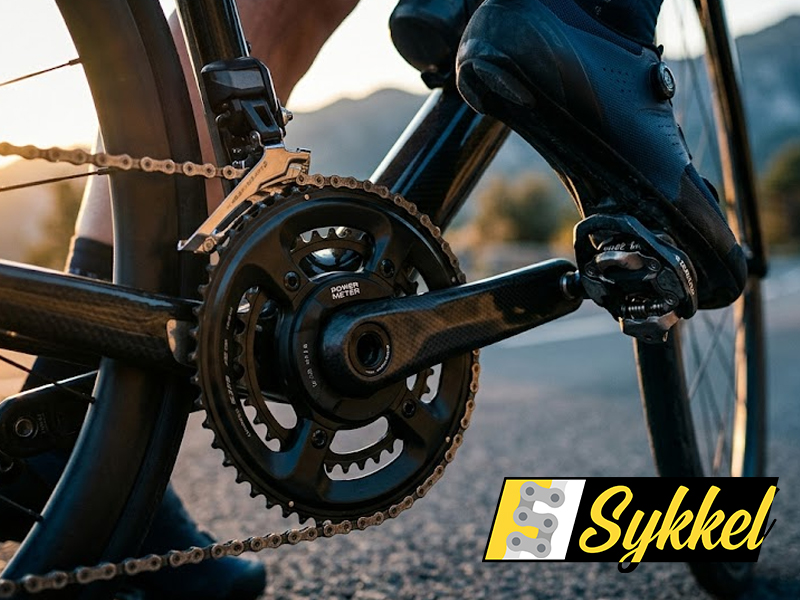
It's just a matter of choice. The 2026 offer is wide, segmented by technology (pedaler, star, crank, pedals), by brand and by budget — from 300 € to more than 2,000 €. This guide reviews the main solutions, compares architectures, and concludes with a recommendation according to your profile.
The two large families: case/pedaler vs pedals
Schematically, the measurement is done in two places on the bike: in transmission (manivelle, star/spider, or integrated pedal) or in the pedals. This is the first arbitration to be made, as it conditions price, accuracy, portability and compatibility.
The pedal / star / crank sensors
Here, the strain gauges are housed in the crank arm, in the star that carries the trays, or directly in the axis of the pedal. It is the historical technology, preferred by pros for its robustness.
Benefits:
- Excellent durability: the sensor is protected from shocks, protected under the bike.
- Often huge autonomy (up to 200 h at Quarq, 300 h+ on Shimano Dura-Ace).
- Insensitivity to temperature variations in recent models (active compensation).
- Independent of the choice of pedals: you keep your favorite holds.
Disadvantages:
- Linked to your transmission: a Quarq AXS sensor only mounts on SRAM AXS, a Shimano only on Shimano. Change group = change sensor.
- Almost intransferable from one bike to another (demountation of the pedal wheel required).
- Left crank versions only measure one leg and extrapolate (see below).
Pedal sensors
The gauges are integrated into the body or axis of the pedal. Technology has exploded in recent years thanks to its flexibility.
Benefits:
- Transferability Queen : one unscrews, one relives on another bike in two minutes ( race bike / indoor bike trainer / rain bike).
- Installation without specific tool, without touching the transmission.
- Independent of your group (Shimano, SRAM, Campagnolo: whatever).
- Measurement as close as possible to the source (foot), with real left/right balance on double versions.
Disadvantages:
- Exposed to shocks (laying on the ground, friction in tight bends, clingings).
- We are forced to the standard pedal holds (Look Keo, Shimano SPD-SL, Speedplay, SPD according to models).
- Generally more modest autonomy (50 to 120 h depending on brands).
- Ground clearance is sometimes reduced (turn angle).
In summary: the pedal/star for whom never changes a bike and wants to "mount once, forget afterwards"; the pedals for whom juggle between several bikes or want the freedom to evolve.
Single sensor (one pedal) vs double (two pedals)
On the pedals — as on the cranks — there are two levels of measurement, and this is a key point often misunderstood.
Simple (single side, usually the left pedal): the sensor measures the left leg and then multiplies the result by two to estimate total power. It's the cheapest front door.
Double (dual-side): a sensor in each pedal, real measure of both legs, plus left/right balance, power phase, and other pedaling dynamics.
The simple sensor trap: extrapolation assumes a perfect 50/50 balance between the two legs. Most cyclists are 49/51 or 48/52, which has no real impact on training. But an imbalance of 5 to 10% — frequent after injury, in some triathletes, or by natural asymmetry — significantly distorts the total measurement. In case of doubt, or if you come back from injury, the double sensor is the assurance of a correct data.
Good to know: most pedal systems are progressive — buy the simple version, then add the second pedal later (Favero Assioma, Garmin Rally, etc.). It's a great way to spread the expense.
The offer by brand (road)
SRAM Quarq (star / pedal)
The wattmeter integrated with the reference pedal at SRAM, mounted on the star (spider). The DZero range equips the Red and Force AXS groups.
- Models: Quarq DZero / RED AXS and FORCE AXS (DUB) sensor star, input version integrated with Rival DUB-PWR axis.
- Accuracy: ±1.5%. Double-sided measurement (left/right separate), temperature compensation 10K, IPX7 sealing.
- Autonomy: until ~200 hours.
- Indicative prices: the star alone around 300–500 €, the complete RED/FORCE AXS pedal of the order of 600 € to more than 1,100 € according to configuration. Only for bicycles in SRAM AXS transmission.
Shimano Power Meter
Integrated sensor on Hollowtech II, two-axis measurement (left/right).
- Models: FC-R9200-P (Dura-Ace) and FC-R8100-P (Ultegra), 2×12 v. The FC-R9100-P was equipped with the previous 11 v generation.
- Accuracy: ±1.5% announced. Active temperature compensation, waterproof. A firmware update (coupled with a compatible Di2 12 v derailleur) improves accuracy according to the position of the tray.
- Autonomy: up to 300 h+, rechargeable Li-ion battery.
- Indicative prices: about 900 € to 1 300 € depending on the version and the dealer.
- Reservation: some independent tests (including DC Rainmaker) have pointed to precision problems with the R9200-P generation, partly corrected by firmware. To consider whether absolute accuracy is a priority.
Favero Assioma (pedals)
The bestseller of the market, Made in Italy, is popular for its price/precision ratio and reliability. Often referred to as "best investment" by testing.
- Models: Assioma UNO (simple, left), Assioma DUO (double), Assioma PRO RS / PRO RS-2 (Shimano SPD-SL body, electronics protected in the axis), PRO MX (SPD, mountain bike/gravel), DUO-Shi (axis to be mounted on Shimano body).
- Accuracy: ±1 %. Cadence, G/D balance (double versions).
- Autonomy: ~50 h originally, until ~160 h on PRO after firmware update. Magnetic charging.
- Weight: UNO 151.5 g/pedal (among the lightest on the market).
- Indicative prices 2026: UNO ~329–435 €, DUO ~438–581 € (often ~449 € in promo). Evolutive UNO → DUO. Compatible Keo look holds (supplied); RS PRO in SPD-SL.
Wahoo pedals (Powrlink Zero / Speedplay)
The only sensor based on the dual-face Speedplay system, interesting for its followers (double entry, low deport, great angular freedom 0–15°).
- Models: Powrlink Zero Single (left) and Dual (double).
- Accuracy: ±1 %, laboratory tested (heritage of indoor bike trainer KICKR). Cadence and G/D balance on the Dual.
- Autonomy: ~75 h, rechargeable battery, IPX7 sealing.
- Public price: ~649.99 € in single, ~999.99 € in double (often ~580 € in single promo). The most expensive pedal systems, to be reserved for the followers of Speedplay.
Pedals Look / Garmin Rally / SRM Exakt
Under the banner "Compatible Road Pedals Look Keo", several actors coexist. Look has developed the most widespread Keo hold ecosystem; on the wattmeters-pedals side in Look standard, the flagship solutions are Garmin Rally RK (and historically) SRM Exakt, as well as the old Look/Polo Keo Power).
- Garmin Rally — Models: RK100/RK200 (Look Keo ports), RS100/RS200 (Shimano SPD-SL), XC100/XC200 (SPD, mountain bike). The "100" are simple (left), the "200" double. Interchangeable bodies between standards via kit.
- Accuracy: ±1 %. Advanced pedaling dynamics (G/D balance, power phase, sitting/standing time).
- Autonomy: up to 120 h (cells LR44/SR44).
- Indicative prices: Rally 100 (single) ~650–700 €, Rally 200 (double) ~1,100–1,200 €. Evolutive via second pedal addition kit.
- SRM Exakt: historical top-of-the-range alternative in Look standard, ±1.5% accuracy, proven reliable but positioned premium (often above €1,000 in double).
Summary table (road)
| Solution | Type | Measure | Accuracy | Autonomy | Indicative price |
|---|---|---|---|---|---|
| SRAM Quarq DZero (RED/FORCE AXS) | Star/pedaler | Double | ±1,5 % | ~200 h | ~300–1 100 € |
| Shimano FC-R9200-P / R8100-P | Pedal | Double | ±1,5 % | 300 h+ | ~900–1 300 € |
| Favero Assioma UNO | Pedal | Simple | ±1 % | 50 hours | ~329–435 € |
| Favero Assioma DUO / PRO RS | Pedal | Double | ±1 % | 50–160 h | ~438–581 € |
| Wahoo Powrlink Zero Single | Pedal | Simple | ±1 % | 75 hours | ~580–650 € |
| Wahoo Powrlink Zero Dual | Pedal | Double | ±1 % | 75 hours | ~1 000 € |
| Garmin Rally 100 (RK/RS) | Pedal | Simple | ±1 % | 120 h | ~650–700 € |
| Garmin Rally 200 (RK/RS) | Pedal | Double | ±1 % | 120 h | ~1 100–1 200 € |
Indicative VAT prices recorded in 2026, variables according to dealers, crank lengths, trays and promotions.
What about the mountain bike (and the gravel)?
The off-road imposes specific constraints: standard SPD holds (double entry, more mud tolerant), exposure to shocks and projections, and increased weight/rigidity requirements in climb.
Two approaches dominate:
- SPD sensor pedals: Garmin Rally XC100/XC200 (compatible holds Shimano SPD) and Favero Assioma PRO MX (SPD, ~194 g/pedal, single version MX-1 or double MX-2). Major advantage: portability, and the ability to switch road 的 mountain bike/grave simply changing body or holds. The MRS X-Power also exists in SPD. Note however: a pedal is more exposed to impacts by mountain bike (cailloux, roots).
- Transmission sensors: on mountain bike, star or crank (type Quarq DFour/XX1, Rotor, or left crank sensors 4iiii/Stages on Shimano XT/XTR cranks) remain a safe value on the durability side, protected from shocks. This is often the most robust choice for committed use.
For a practitioner road + mountain bike/grave wanting a single sensor, the interchangeable SPD pedals (Garmin Rally XC, Assioma PRO MX) or a pedal system with a changing body offer the best versatility. For a pure mountain biker looking for maximum robustness, a transmission sensor is more serene.
Recommendation
There is no universal "best sensor" but a better sensor for your situation. Here's how to decide:
- First sensor, tight budget, one bike: a Favero Assioma UNO (~330–435 €) or an entry-level left crank. Largely enough to structure its sessions, calculate its FTP and make serious progress. Evolutive towards the double later.
- Best precision/polyvalence ratio (our default recommendation): on Favero Assioma DUO (or PRO RS in SPD-SL). Accuracy ±1%, double measure, transferable from bike to bike, reliable and at the fairest price of their class. This is the smartest investment for the vast majority of cyclists, and it will remain so for several seasons.
- Several bikes / need to transfer often: any system with pedals (Assioma, Garmin Rally, Wahoo). We take it down, we go up, we drive.
- One bike, never change, maximum robustness, SRAM or Shimano homogenous transmission: a sensor pedal/Star (Quarq for SRAM AXS, Shimano Power Meter for Shimano) — go upstairs once and forget it.
- Known asymmetry, injury return, triathlon: it is imperative that double sensor for a fair data.
- Faithful Speedplay: Wahoo Powrlink Zero, only option of the standard.
- mountain bike / engravel: sPD pedals (Garmin Rally XC, Assioma PRO MX) for versatility, transmission sensor for pure robustness.
Whatever your choice, prefer a model to active temperature compensation and ±1 % if absolute accuracy counts: the data must be stable from one output to another, otherwise it does not help to track progress. And remember that a sensor doesn't make you progress on your own — that's what you do with training.